Idempotency Keys and Webhooks for Generative Media APIs
Why POST retries must not double-charge credits, how Wavemaker's Idempotency-Key and signed kernel_run webhooks work, and patterns for batch jobs, approval gates, and training jobs.

Generative media APIs are async and expensive — exactly the combination that breaks naive HTTP clients. Timeouts, queue retries, and CI re-runs must not spawn duplicate credit holds. Wavemaker treats idempotent dispatch and signed webhooks as first-class on the workflow API surface (slug runs, private spec runs, Training Studio, and DCO). This post explains the mechanics integrators rely on in production — not managed POST /videos (see Automate video creation with the API for that path).
The failure mode you are preventing
Imagine a nightly job that POSTs five hundred slug runs. Halfway through, Kubernetes evicts the pod. The job restarts from SKU 1. Without idempotency, SKUs 1–250 submit again — double holds, double renders, angry finance.
Idempotency keys fix submit duplication. They do not replace memoization inside a run (identical block inputs can still memo-hit on a new run with a new key). Both layers matter: keys for transport retries, memo keys for creative iteration (Memoized workflow runs).
Idempotency-Key semantics
Send Idempotency-Key: <string> on dispatch POSTs (≤255 characters; UUID v4 recommended). Rules:
| Behavior | Detail |
|---|---|
| First request | Creates the run, places the credit hold, returns 202 with run_id. |
| Retry with same key + same body | Returns the original run; idempotent_replayed: true; HTTP 200/202 depending on route. |
| Same key + different body | Rejected — keys bind to the first payload shape. |
| Scope | Per organization (API key’s org), not global. |
Workflow slug example:
curl -X POST https://api.wavemaker.io/api/v1/w/product-teaser/runs \
  -H "Authorization: Bearer mcp_your_key" \
  -H "Idempotency-Key: catalog-2026-08-07-sku-4412" \
  -H "Content-Type: application/json" \
  -d '{"inputs":{"product_url":"https://shop.example/p/4412"}}'
MCP run_hub_workflow exposes the same header as idempotency_key. Agents retry tool calls aggressively — pass a stable key derived from your business id, not random() per attempt.
Key design patterns
- SKU + content hash:
teaser-{skuId}-{hash(url, heroImageEtag)}— product updates naturally get new keys. - CI build id:
gha-{repo}-{run_id}-smoke— one smoke run per pipeline execution. - User click: never reuse across users; include tenant id in the key string.
If you lose the HTTP response but still hold the key, replay with the same key before minting a new one — otherwise you may create a second run.
Metadata correlation (webhooks + reads)
Every kernel submit accepts metadata: up to 16 string key/value pairs, echoed on:
GET /api/v1/kernel-runs/:id- Batch
GET /api/v1/kernel-runs?ids=… - Every
kernel_run.*webhook
Use metadata for SKU, order id, or feature flag — not secrets. Webhook handlers should route on metadata before hitting your database.
Webhook delivery contract
Pass webhook_url (HTTPS, no embedded credentials) and optional webhook_secret on submit. When the run reaches a terminal or approval state, Wavemaker POSTs JSON with:
| Header | Purpose |
|---|---|
X-Webhook-ID | Dedupe deliveries in your consumer |
X-Webhook-Timestamp | Reject replays outside your skew window |
X-Webhook-Signature | v1,<hmac-sha256> over id.timestamp.body |
Verify before side effects. Store processed X-Webhook-ID values with TTL ≥ your retry horizon.
kernel_run event family
| Event | When | Payload highlights |
|---|---|---|
kernel_run.completed | Success, settled to actual | outputs, credits_charged, metadata |
kernel_run.failed | Terminal failure | error, metadata |
kernel_run.cancelled | User/API cancel | partial spend retained |
kernel_run.awaiting_approval | approvalGate node | instance_key, message |
Resume approval:
curl -X POST https://api.wavemaker.io/api/v1/kernel-runs/$RUN_ID/approval \
  -H "Authorization: Bearer mcp_your_key" \
  -H "Content-Type: application/json" \
  -d '{"instance_key":"from-webhook","decision":"approved"}'
Human-in-the-loop patterns: Human approval gates in AI pipelines.
Training jobs and DCO
POST /training-jobs accepts the same webhook fields (training_job.awaiting_checkpoint, failures, completion). DCO uses a separate dco.* subscription model on POST /api/v1/dco/webhooks — do not assume kernel headers on catalog events.
Render webhooks (POST /renders) ship unsigned today — poll GET /api/v1/renders/:id when authenticity matters.
Poll vs webhook in production
| Pattern | When |
|---|---|
| Webhook primary | Server-side apps, CI with ingress, queue workers |
| Poll fallback | Local scripts, air-gapped staging |
| Tight poll loops | Avoid — use exponential backoff on GET /kernel-runs/:id |
Slug-run architecture diagram: Every workflow is an API endpoint (/blog/diagrams/slug-run-api.svg).
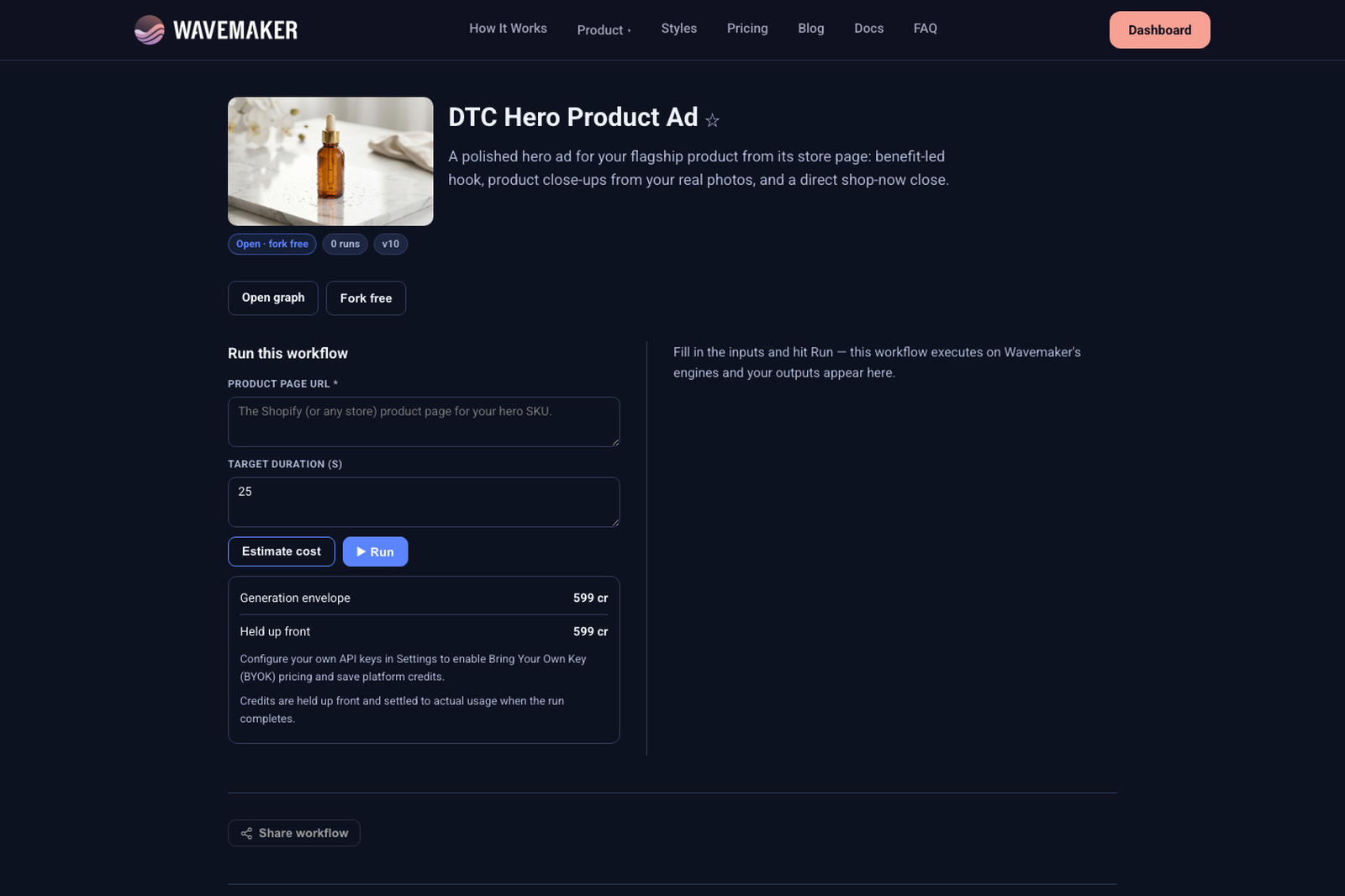
Estimate / quote before a credit hold on a slug run.
Workspace tool runs and static ads
Idempotency extends beyond kernel slug submits:
POST /api/v1/workspaces/:id/tools/:tool_name— upscale, reviews, and workspace composites acceptIdempotency-Keyon dispatch. MCP dynamic workspace tools mirror the header when exposed.POST /api/v1/static-adsand variant actions — batch creative pipelines retry safely when keys include variant id + action name.- DCO produce/export/sync — catalog video operators rely on keys for autopilot loops; events use the
dco.*family with subscription secrets rotated viaPOST /api/v1/dco/webhooks/:id/rotate-secret.
Kernel integrators can ignore DCO until they need catalog slots — but the same HMAC verification code often handles both once you normalize event type prefixes.
Clock skew and replay attacks
Reject webhooks when X-Webhook-Timestamp differs from server time by more than your chosen window (five minutes is common). Store processed webhook ids in Redis or SQL with TTL. For idempotency keys, the server — not the client — decides replay; never “increment” a key on retry.
Observability fields to log
On dispatch: Idempotency-Key, slug or spec id, metadata keys (not values if PII). On webhook receipt: X-Webhook-ID, event type, run_id, settled credits_charged. Correlate with GET /kernel-runs/:id node arrays when debugging partial failures — each node records spend and memo hit flags in structured logs documented under observability.
Comparison with managed video webhooks
Managed POST /videos jobs emit workspace-style completion events with the same signature scheme when webhook_secret is set — but job ids, pricing, and polling URLs differ. Workflow slug integrators should not assume video job handlers parse kernel_run.completed payloads without schema updates. Keep handlers separate or branch on event type string.
Failure handling checklist
- Dispatch 5xx or timeout: retry with the same Idempotency-Key and body.
- Webhook 5xx from your server: Wavemaker retries; make handlers idempotent on
X-Webhook-ID. - 429 KERNEL_DAILY_RUN_CAP: backoff; cap is 200 runs/org/24h on kernel submits.
- Partial batch failure: metadata lets you reconcile which SKUs completed without listing all runs.
Idempotency in multi-region consumers
If you run webhook consumers in two regions, both may receive retries — X-Webhook-ID dedupe must be global (DynamoDB, Postgres unique index), not in-memory only. Idempotency keys are org-global too: failover submit from secondary region with same key must replay, not duplicate.
Training job webhooks
training_job.awaiting_checkpoint pauses until pick_checkpoint — agents and CI should not poll training jobs every second. Webhook + email notification defaults reduce noise. Cancelled training jobs may not emit kernel_run events — use training-specific handlers.
Batch GET for reconciliation
Nightly jobs list pending SKUs from your DB, batch GET /kernel-runs?ids= for stale run_ids, reconcile status without waiting for webhooks lost during deploy. Complement webhooks — do not replace unless traffic is low.
Load testing idempotency
Before Black Friday catalog runs, script 100 identical submits with one key in staging — assert 99 replays and single hold. Then script 100 distinct keys — assert cap handling and webhook throughput on your receiver. Staging org keys avoid production royalty side effects.
Where to go next
- Slug runs end-to-end: /workflow-api and Workflows as API endpoints
- CI without duplicate submits: Slug-run workflows from CI
- OpenAPI reference for all routes: OpenAPI for generative media
- Developer tables: /developers
Frequently asked questions
- Which Wavemaker endpoints accept Idempotency-Key?
- Kernel workflow submits (POST /workflows/:id/runs and POST /w/{slug}/runs), DCO produce/export/sync, static-ads dispatch, workspace tool runs, and several studio probes — any dispatch that reserves credits before async work starts.
- How long is an idempotency key remembered?
- Per organization, keyed by Idempotency-Key string (≤255 chars). A replay returns the original run with idempotent_replayed: true and does not place a second hold.
- How do I verify a webhook signature?
- When webhook_secret is set, compute HMAC-SHA256 over '<X-Webhook-ID>.<X-Webhook-Timestamp>.<raw body>' and compare to X-Webhook-Signature: v1,<hex>. Reject stale timestamps and duplicate X-Webhook-ID deliveries.
- What events fire for workflow runs?
- kernel_run.completed, kernel_run.failed, kernel_run.cancelled, and kernel_run.awaiting_approval when an approvalGate node pauses the graph. Training jobs emit training_job.* separately.