Remixing AI Workflows: Lineage, Forks, and Credit Where It Is Due
Hub remix and fork stamp lineage on workflow_spec_versions — parent slug, author org, premium_derived rules — so derivatives stay traceable and Open royalties reach the right creator.

Remix is Hub vocabulary for “take this published workflow, copy it into my org, and iterate.” Lineage is the audit trail — parent slug, author org, version pins — so credit, royalties, and moderation stay honest. Wavemaker stamps lineage at fork time; app pages at /w/{slug} surface it for runners and creators exploring the Hub.
Why lineage exists
AI workflow marketplaces fail when derivatives are anonymous:
- Creators lose 10% Open royalty attribution when runners use unattributed copies.
- Teams cannot tell which template version shipped a client campaign.
- Premium graph leaks propagate if clones republish without
premium_derivedguards.
Lineage makes the graph social without hiding economics — remix culture plus marketplace economics.
What gets stamped on fork/remix
Fork/clone creates a new workflow_specs row linked to parent workflow_spec_versions:
- Parent spec id and published version
remixed_from_slug/ name for UI banners- Author org attribution on Hub cards (
author_org_name, link to/creator/{orgSlug}) - Access inheritance rules for premium-derived graphs
Your copy opens in the AI workflow builder — edit, compile, run with memoization, publish your own listing when moderation approves.
Runner-facing UI on /w/{slug}
RemixBanner — “Remixed from {parent} by {org}” with tombstone when parent delisted.
VersionsSection — published version history for the workflow you are viewing.
RemixesSection — direct child workflows that published from this parent (GET /hub/workflow/{slug}/remixes).
Showcase gallery — community outputs verified against runs; owner moderation queue (showcases post).
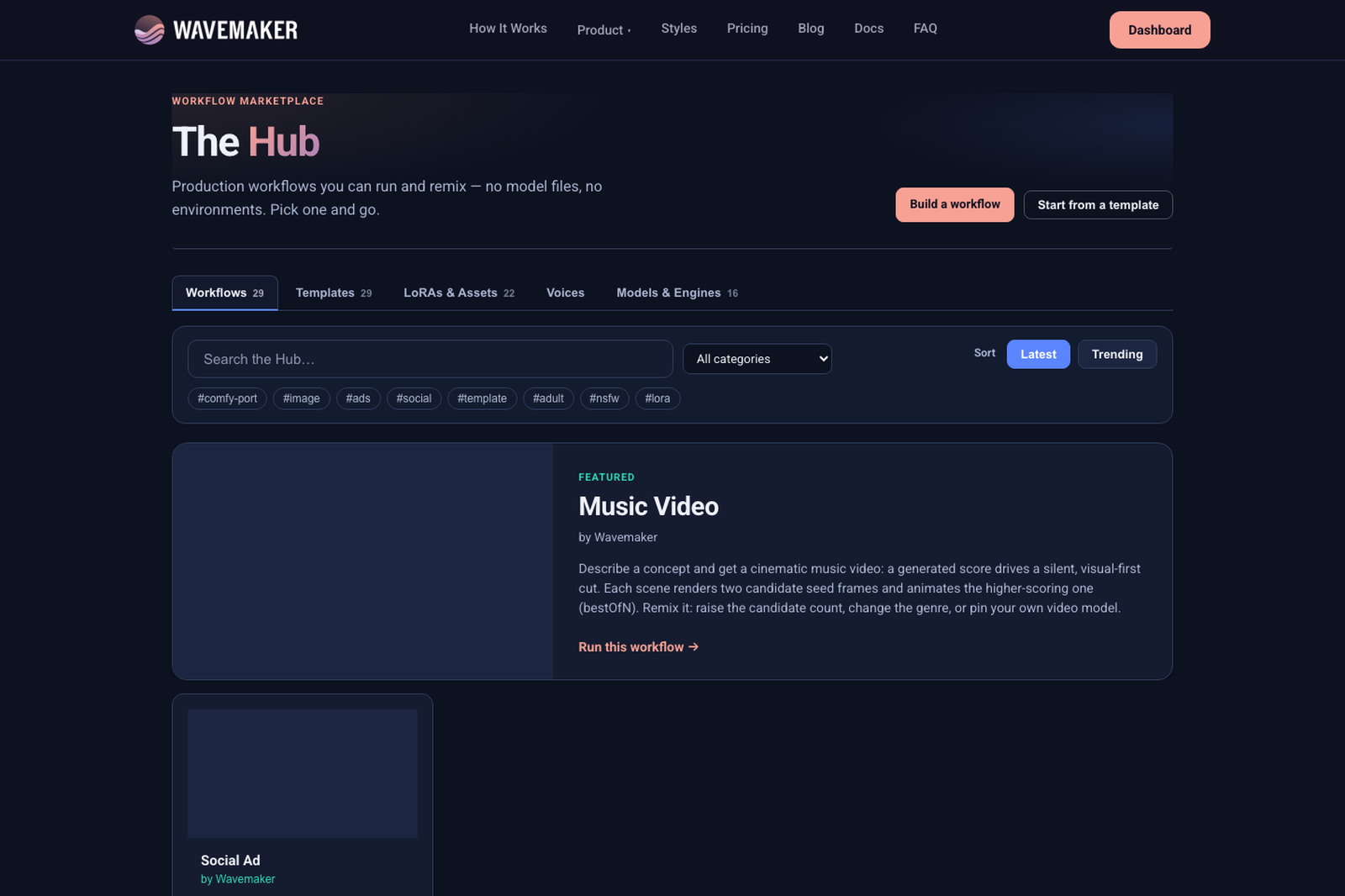
Hub catalog — browse runnable workflows and assets.
Virality: Made with {workflow}
Kernel runs stamp workflowSpecId, workflowSlug, workflowName onto produced composition meta when launched from a workflow pin — share pages can link back to /w/{slug}. The data path is forward-compatible for gallery bridges; lineage is written at compose time in kernel graph runs.
Notifications and spread metrics
Foreign fork and remix publish events can insert creator notifications — optional bell in dashboard/chat sidebars. Earnings tab fork_count / remix_count help you see spread beyond raw run totals.
Open remix vs Premium clone
| Action | Typical use | Economics |
|---|---|---|
| Open fork | Community templates, UGC ad variants | Parent earns royalty on foreign runs of their listing; your publish is a new spec |
| Premium clone license | Buy closed graph legally | One-time 80/20 clone fee; derivative tagging |
Read Publish your AI workflow as an app before choosing access mode on your derivative.
Comfy import is not remix
Comfy import transpiles external JSON into a new draft spec — no parent slug until you publish and others fork. Position importers honestly: creative intent carryover, not automatic lineage to a Civitai uploader (import ComfyUI workflows).
Practical remix playbook
- Fork from
/w/{slug}or Hub card — do not paste JSON by hand (loses lineage). - Swap bindings in spec panel — attach Hub LoRAs via Use in workflow (
?attach_asset=). - Add quality contracts where the parent was too loose (quality contracts).
- Publish with a distinct cover and showcase seed outputs.
- Link back to parent in description — good citizenship, better SEO.
Where to go next
- Tour of the Workflow Hub
- Run Hub workflows from chat
- Docs: Using the Hub
- Builder: /ai-workflow-builder
Delisted parents and tombstones
When a parent workflow delists, RemixBanner tombstones the link — child specs remain runnable if your org already forked. Runners still see lineage honesty instead of 404 confusion. Premium parents may delist while clones remain premium_derived — read republish rules before listing a derivative Open.
Composition meta and share pages
Kernel graph runs stamp workflow meta on VideoComposition.meta for Made-with links on /v/{id} when gallery sharing exists. Pins from chat composer always create kernel runs (run from chat) — lineage written at compose time even if share UI catches up later.
Community growth metrics
Earnings tab remix_count and fork_count help creators decide whether to invest in Open templates vs Premium closed graphs. Notifications on foreign fork/remix are optional nudges — respond with showcase features or updated parent versions to steer community without locking remix culture entirely.
API fork vs UI fork
Fork endpoints stamp lineage server-side — copying JSON manually loses parent ids and breaks RemixBanner truth. Always fork through Hub or authenticated fork API so remixed_from_slug survives into your publish.
Version sections for runners
VersionsSection helps agencies pin “approved template v3” while v4 beta publishes — communicate semver in changelog text on app page. Runners passing version on API submit stay on frozen graph — remixers may fork v3 while you evolve v4 Open parent.
Showcase attribution
Showcase items from verified runs carry run provenance — remixers showcasing outputs still attribute your workflow slug in gallery metadata when runs used your spec id. Encourage showcase submissions after fork to grow social proof without giving up Open royalty on the spec itself.
Field notes
Marketing teams should link parent and child slugs in both directions for SEO — parent RemixesSection lists children; child RemixBanner links up. Delist parent when retiring SKU but keep tombstone text honest. Premium clone buyers expect lineage badge — do not strip metadata when rebranding clone internally.
Platform links worth bookmarking
The AI workflow builder landing orients new authors; /workflows/new is the authenticated entry. Published runners live at /w/{slug} with JSON Schema exposed on GET /api/v1/w/{slug}. Hub discovery is /hub. Kernel contracts are unauthenticated at GET /api/v1/openapi.json and GET /api/v1/workflow-spec-schema. Docs cluster: workflows overview, building workflows, running workflows, publishing and earning. Comfy transpile honesty: /comfyui and import ComfyUI workflows. API integrators: workflows as API endpoints and agent-driven MCP builder. Next step for this topic: open /workflows/new and apply the pattern from remixing ai workflows lineage, then publish to /hub when the run is stable.
Glossary (quick)
WorkflowSpec — canonical IR JSON. Compile gate — validate before run/publish. Open royalty — 10% to creator on foreign settled platform credits. Premium — creator-priced runs with 80/20 success split. Memoization — content-addressed skip for unchanged blocks. approvalGate — human pause with webhook. bestOfN — parallel candidates, scoreBy winner. Lineage — fork/remix parent attribution. Slug run — execute published workflow by Hub slug without chat orchestrator.
Legal framing (not legal advice)
Lineage metadata supports attribution and royalty accounting; it is not a copyright license. Open fork terms still require compliance with platform AUP and moderation. Premium clone license is a product feature for graph access — consult your counsel for external licensing language on your app page copy.
Takeaways
- Fork/remix stamps remixed_from_slug and parent org attribution.
- RemixBanner, VersionsSection, RemixesSection on
/w/{slug}. - Open fork culture vs Premium clone license (80/20 one-time).
premium_derivedlimits naive republication of premium clones.- Manual JSON copy loses lineage — use Hub fork API.
- Foreign fork notifications optional for creators tracking spread.
- Earnings fork_count / remix_count supplement royalty totals.
- Comfy import creates new drafts without parent slug until you publish.
- Browse /hub then fork into /ai-workflow-builder.
One-line reminder
Published workflows at /w/{slug} use the same kernel runtime as private editor runs — gates, memoization, Open 10% royalty, and Premium 80/20 splits do not change because the runner discovered the workflow from chat, Hub, or API. The AI workflow builder remains the authoritative place to add or move approvalGate, bestOfN, retryUntil, style locks, covers, and showcase-worthy outputs before you publish.
Frequently asked questions
- What is the difference between fork and remix on the Hub?
- Both copy a published workflow into your org with lineage metadata. Remix is the product language on app pages — the graph opens in your editor with parent attribution. Fork is the API/catalog term for the same lineage-stamped copy.
- Can I publish a remixed workflow as Open if the parent was Premium?
- Premium-derived clones carry premium_derived constraints — public republish rules differ from an original Open fork. Check access mode on the parent and clone license terms before listing.
- Where does lineage appear for runners?
- On /w/{slug}: RemixBanner (Remixed from … by …), VersionsSection, RemixesSection for direct child publishes, and composition meta Made with {workflow} on shared videos when kernel run provenance is present.
- Do remixes affect creator royalties?
- Open royalty is on foreign runs of your published spec id. Forks create new specs — royalties follow the published listing’s org and access mode, not informal copies.