AI Workflow Marketplace Economics: Open Royalties, Premium 80/20, and Clone Licenses
How Wavemaker settles creator earnings — 10% open royalty on foreign runs, 80/20 premium split on success, clone licenses, ledger idempotency, and the Earnings tab metrics creators actually see.

Creators ask one question before publishing: when someone runs my workflow, where do the credits go? Wavemaker’s marketplace is not a black box — Open listings pay a 10% royalty on foreign runs from the platform share; Premium listings charge your per-run price with an 80/20 creator/platform split on success; clone licenses sell graph access with the same split. This post maps those rules to what you see in the Hub and Earnings tab.
Two access modes, two business models
When you publish from the AI workflow builder, you choose:
Open — discovery and remix culture. Anyone entitled can fork, embed, and run. You earn 10% of settled platform credits when another org runs your workflow. The royalty is carved from the platform’s share — runners are not surcharged a hidden ten points on top of quoted block costs.
Premium — closed graph optionality with a creator price (1–1,000 credits per run). Runners pay block costs plus your premium. On success only, you receive 80% of the frozen premium charge; the platform keeps 20%. Failures and cancels refund the premium — charge-on-success is load-bearing for trust.
Optional clone license (1–10,000 credits one-time): buyer gets a copy with lineage; settlement 80/20; premium_derived blocks naive public republish of the clone as if it were original IP.
Full product rules: Publishing and earning and workflows overview § Creator economics.
What “foreign run” means for royalties
Open royalty triggers on foreign runs — runner org ≠ creator org. Internal team reruns do not self-pay royalty. BYOK-heavy runs still compute royalty on the settled platform credit portion per policy — platform fee lines remain in quotes.
Premium runs always attribute premium credits to the spec owner on success, regardless of fork lineage, subject to moderation and delist rules.
Runner experience on /w/{slug}
Runners see itemized estimates on /w/{slug}: generation envelope, creator premium line, no premium graph leak. Signed-out users get public estimate preview; auth unlocks run and fork/clone purchases.
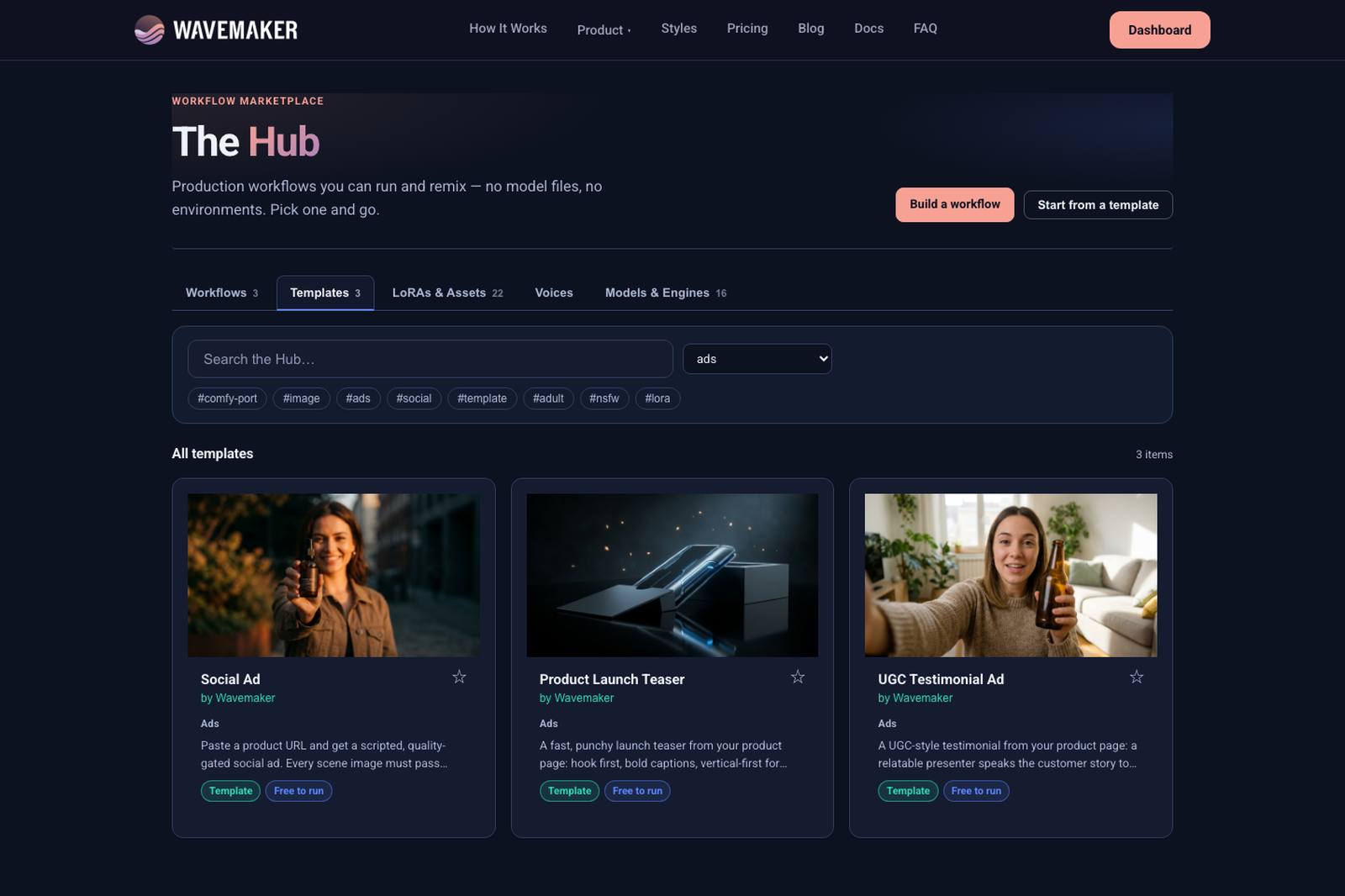
Hub grid of ad-style workflow covers.
Hub cards show author org links to /creator/{orgSlug} — attribution is batch-resolved, not N+1. Trending sort uses seven-day run velocity; Drops are editorial when enabled.
Earnings dashboard and spread metrics
/workflows → Earnings tab (GET /creator/earnings?days=N) aggregates ledger-backed totals. Per-workflow rows include fork_count and remix_count so you see remix culture, not just run volume. Model assets show use_count when others bind your public LoRAs or voices.
Fork and remix events can enqueue creator notifications (foreign fork, remix publish) — useful when a template escapes into a niche and you want to engage remixers (remixing workflows).
Tips, guest trials, and scope boundaries
When enabled by flag, asset tips on public model assets follow a separate 80/20 settle path from runner tips — distinct from workflow royalty lines (changelog). Guest trial on select open SFW image workflows is a acquisition surface — not a royalty bypass; trials run on platform org with watermark rules.
This post focuses on publish access modes — not affiliate cash programs or chat video billing.
Reconciliation and operator hygiene
Daily kernel-royalty-reconcile compares succeeded runs with royalty_credits or premium_credits_charged to ledger idempotency keys. Mismatch emits structured logs for human investigation — automated re-grant is intentionally forbidden.
Creators should treat the Earnings tab as cash-out truth; runners should treat pre-run quotes as spend truth. Both tie back to the same compile envelope and node settlement in kernel-run.ts.
Strategy: which mode when?
| Goal | Mode |
|---|---|
| Template marketing, community remix | Open + strong cover/showcase |
| Proprietary high-value graph, API SKU | Premium + optional clone |
| Agency recurring revenue on same scaffold | Premium per run or org-private fork |
| LoRA/voice binding revenue | Publish assets separately; workflow binds them |
Pair Open listings with workflow showcases and Hub search FTS so discovery matches economics.
Where to go next
- Publish your AI workflow as an app
- Workflow platform field guide (pillar)
- Hub tour: Tour of the Workflow Hub
- Build and publish: /ai-workflow-builder
Ledger keys integrators never see but finance should
Settlement writes idempotent ledger rows: royalty_{runId} for open foreign runs, premium_{runId} for the creator share of premium charges. Refunds use refund_{holdIdempotencyKey} shared across success, failure, and cancel paths — duplicate refund attempts no-op. Daily reconciliation compares run rows to ledger — mismatches log kernel_royalty_reconciliation_mismatch for human ops, never silent auto-pay.
BYOK and marketplace lines
BYOK nodes bill platform fee (20% of platform-key price, min 1 credit) — see BYOK doc. Open royalty computes on settled platform credits after BYOK fee lines — creators still earn on foreign usage when platform share exists. Quote UI on /w/{slug} separates generation envelope from premium line items so runners understand creator vs engine charges.
Collusion and velocity monitoring
Live Ops tracks collusion velocity pairs (creator org × runner org > 25 foreign runs/24h) — marketplace health signal, not creator-facing UI. Legitimate agency runners may spike; sustained patterns trigger review. Premium pricing caps (1–1,000 cr/run) and clone caps (10,000 cr) bound worst-case settlement exposure.
Tips on assets (separate rail)
When workflowAssetTipsEnabled, public model assets may accept runner tips with their own 80/20 settle — distinct ledger from workflow royalty. Workflow posts in this cluster focus on spec publish modes; asset tips reward bindable LoRAs/voices in graphs you publish Open.
Self-run vs foreign-run accounting
Creators testing /w/{slug} on their own org do not earn open royalty on themselves — accounting would be circular. Foreign runs from another org’s API key or JWT are the royalty events. Agencies with multiple orgs should use separate orgs for creator vs client roles when testing economics.
Premium failure refunds
Premium lines refund on failure/cancel — integrators must handle webhook kernel_run.failed without assuming premium captured. Open royalty only applies on succeeded foreign runs with settled platform credits — a failed run after heavy generation still costs runner block actuals, but no premium or royalty surprise on failure paths.
Clone economics for educators
Educators selling clone license at high tier (up to 10,000 cr) should document what buyers receive — graph copy with lineage, not automatic public republish rights. premium_derived guards against clone resale as original premium SKU.
Earnings tab time windows
GET /creator/earnings?days=N aggregates ledger — align N with your finance calendar. Fork/remix counts are lifetime or windowed per API version — use them directionally for community health, not GAAP revenue recognition.
Field notes
Finance pairing: export creator earnings CSV from admin if available; match to ledger idempotency keys in support tooling. Dispute resolution: reconciliation cron is assert-only — human payout correction, never silent re-grant. Communicate 10% royalty as ‘platform-funded’ so creators do not think runners pay extra ten percent on top of quoted price.
Platform links worth bookmarking
The AI workflow builder landing orients new authors; /workflows/new is the authenticated entry. Published runners live at /w/{slug} with JSON Schema exposed on GET /api/v1/w/{slug}. Hub discovery is /hub. Kernel contracts are unauthenticated at GET /api/v1/openapi.json and GET /api/v1/workflow-spec-schema. Docs cluster: workflows overview, building workflows, running workflows, publishing and earning. Comfy transpile honesty: /comfyui and import ComfyUI workflows. API integrators: workflows as API endpoints and agent-driven MCP builder. Next step for this topic: open /workflows/new and apply the pattern from ai workflow marketplace economics, then publish to /hub when the run is stable.
Glossary (quick)
WorkflowSpec — canonical IR JSON. Compile gate — validate before run/publish. Open royalty — 10% to creator on foreign settled platform credits. Premium — creator-priced runs with 80/20 success split. Memoization — content-addressed skip for unchanged blocks. approvalGate — human pause with webhook. bestOfN — parallel candidates, scoreBy winner. Lineage — fork/remix parent attribution. Slug run — execute published workflow by Hub slug without chat orchestrator.
Frequently asked questions
- How much do creators earn on Open published workflows?
- 10% of settled platform credits on foreign runs — funded from the platform share, not an extra charge on top of runner spend. Your own org's runs do not pay royalty to yourself.
- How does Premium pricing split?
- You set 1–1,000 credits per run at publish; the runner's premium charge is frozen at submit and collected on success only. Creator receives 80%; platform 20%. Failed or cancelled runs refund the premium charge.
- What is a clone license?
- Optional one-time 1–10,000 credit fee for buyers to clone a premium workflow into their org with lineage stamped. Settlement is 80/20; cloned specs carry premium_derived rules on public republish.
- How are payouts verified?
- Ledger rows use idempotent keys (royalty_{runId}, premium_{runId}). A daily reconciliation cron asserts succeeded runs with royalty or premium credits match ledger amounts — drift logs kernel_royalty_reconciliation_mismatch for ops.