Flux, SDXL, and Krea LoRAs: What Runs on Wavemaker Today
An honest map of which LoRA base models train and execute on Wavemaker (krea2, ltx, wan, hunyuan, elevenlabs) versus library-only Flux and SDXL imports.

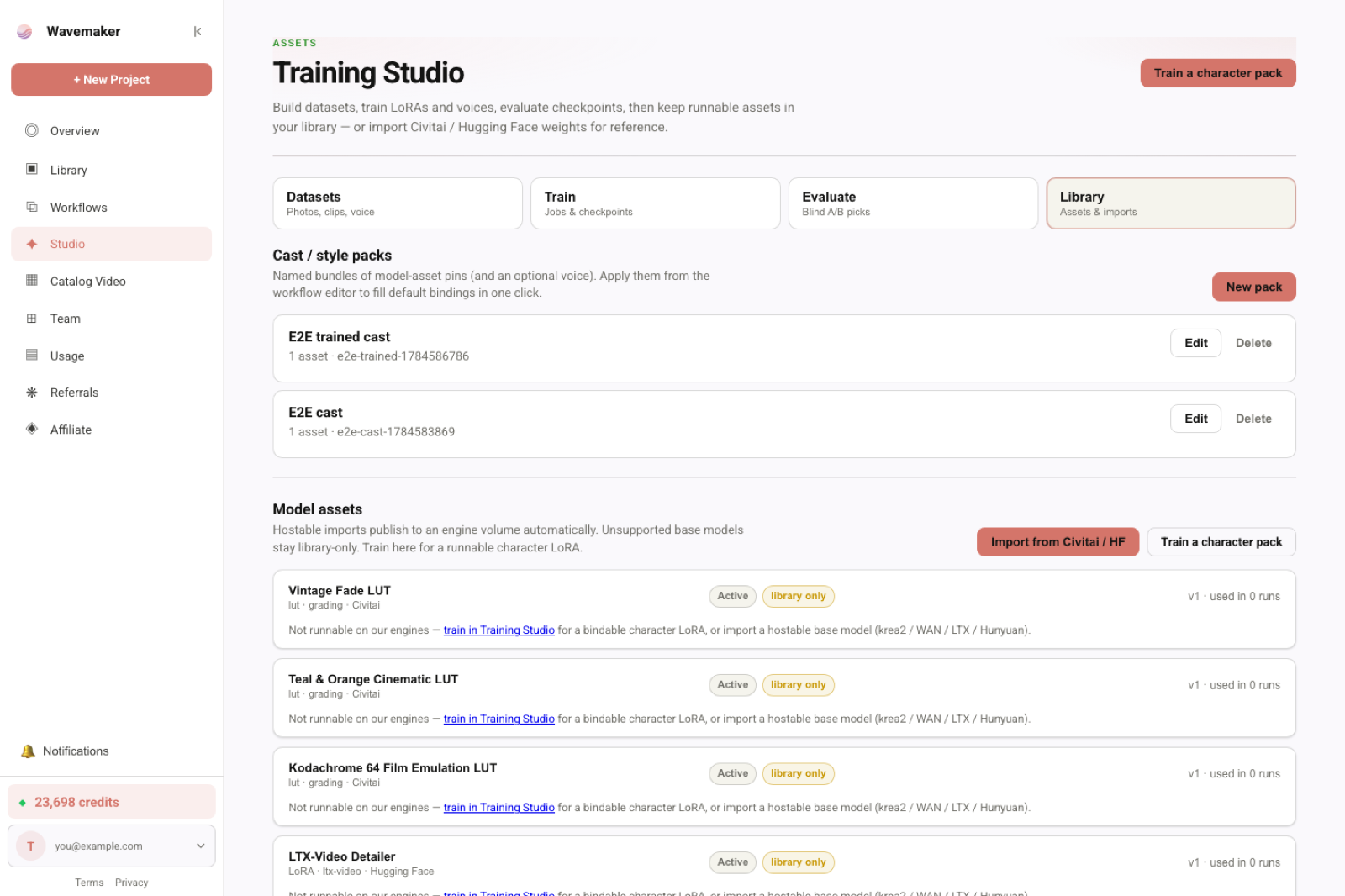
Flux and SDXL LoRAs are library-only on Wavemaker until their engine families mount; krea2, ltx, wan, hunyuan, and elevenlabs paths train, pick epochs, and run in workflows today. Plan imports and Comfy transpiles against that matrix—not against “whatever Civitai hosts.”
Hub catalog — browse runnable workflows and assets.
Why compatibility honesty exists
Creators collect LoRAs across base models—SDXL realism packs, Flux style merges, Wan video adapters. A hosted platform must say which weights actually execute on managed GPUs, or users blame the tool when a graph “has the LoRA node” but produces base-model output.
Wavemaker separates:
- Runnable assets — trained or imported weights on mounted engines (krea2/ltx/wan/hunyuan/elevenlabs)
- Library-only assets — Flux/SDXL imports stored with license attestation, no inference until mount
The LoRA training landing page states this upfront; this article explains how it shows up in Studio, Comfy import, and workflow binding.
Runnable matrix (2026 product contract)
| Family | Train in Studio | Run in workflows | Typical use |
|---|---|---|---|
| krea2 | image_lora | Image blocks | Characters, products, styles |
| ltx | image_lora | Image / permissive paths | Still frames tied to LTX video |
| wan | video_lora, wan_pair | Video blocks | Motion / look packs |
| hunyuan | video jobs | Video blocks | Alternate video backend |
| elevenlabs | voice | Narration nodes | Voice clone with consent |
| Flux (import) | No | No (library) | Catalog + future mount |
| SDXL (import) | No | No (library) | Catalog + future mount |
Pricing when you do train: image from ~60 credits, video from ~200, voice ~30 at default steps—cite only those bases from product docs, not third-party hosting quotes.
ComfyUI import behavior
When you import ComfyUI workflows, LoRA loaders map to platform blocks only when filenames match Library entries on runnable bases. Otherwise the import report lists Assets to resolve:
- Import LoRA to Training Studio
- Confirm runnable vs library-only badge
- Re-import workflow so bindings attach
Transpile carries creative intent—it does not execute arbitrary Comfy nodes or smuggle unsupported weights into silent no-ops.
Training beats importing (when you need runnable now)
If your Civitai bookmark is SDXL but your deliverable is a Wavemaker app this week, train a krea2 character/product LoRA from your photos. Train a character LoRA and product LoRAs for ecommerce cover dataset angles.
Imported Flux merges remain valuable as reference—just don’t plan production slug-runs on them yet.
Binding picker gates
The workflow editor asset picker filters incompatible bases—only runnable, version-pinned assets appear for a slot. This prevents publishing graphs that reference library-only weights users cannot execute.
Cast packs inherit the same compatibility rules when you apply packs to spec bindings.
Epoch picks still matter on krea2
Runnable does not mean “automatic quality.” Pick epochs manually; Flux users new to Wavemaker often skip grid review because SDXL habits trained them on “last file wins.”
Voice is a separate compatibility class
ElevenLabs-path voice clones require consent records—not image LoRA logic. See voice training with consent.
FAQ for producers migrating from local Comfy
“Can I upload my 30 SDXL LoRAs for storage?” Yes—library-only with license notes.
“Will transpiled graphs look identical?” No—transpile explainer covers sampler/seed drops.
“How do I test strength?” Only runnable bindings participate—strength tuning guide.
General consistency without retargeting SEO
Character consistency across scenes combines references, LoRAs, casting, and review gates—see /blog/consistent-characters-across-scenes/. Compatibility knowledge tells you which LoRA weights can participate, not the whole video strategy.
Engine mount roadmap mindset
Library-only is not “broken import”—it is honest staging. When Flux or SDXL mounts arrive, bindings will still require version pins and moderation review; cataloged imports accelerate onboarding because filenames and licenses already live in org Library. Until then, plan krea2 training for revenue-critical paths.
Mixed-base Comfy graphs
A single Comfy JSON may reference three base families. Transpile reports each LoRA line separately—expect partial success. Resolve runnable lines first, swap SDXL lines for trained krea2 assets, then re-import. Document intentional creative changes when swap alters look (transpile is intent-preserving, not pixel-preserving).
Team policy template
Publish an internal one-pager:
- Allowed runnable bases (krea2/ltx/wan/hunyuan/elevenlabs)
- Import allowed for archive only vs production
- Epoch pick required human
- Eval promote before external Hub publish
Link to /lora-training as canonical pricing/engine truth.
Support and customer success scripts
When users report “LoRA does nothing,” first check library-only badge, then binding version pin, then strength zero or missing bind. Three checks solve most tickets without retraining.
Future mounts and communication
When SDXL/Flux mounts ship, communication will name engine families explicitly—library items promote to runnable only after mount validation, not silently overnight. Plan comms to remixers who stored weights for months.
Developer ergonomics in binding code
pickerAssetsForSlots mirrors UI—automations must pass same base model slot types or binds fail validation. Read model assets before scripting bulk binds.
Field notes for compatibility planning
Maintain an internal matrix spreadsheet: asset filename, base family, runnable yes/no, workflow ids using it, Comfy import status. Update the column when Civitai import completes—filenames must match graph literals. When marketing promises “bring your LoRA,” qualify with runnable families or train krea2—Flux library-only surprises are support tickets. Educate remixers on Hub that SDXL pins in screenshots may not execute here. Dev teams: test binding gates in staging org before flipping production templates. Pair compatibility reviews with train online when clients migrate off home Comfy—transpile plus library honesty beats silent failure. Quarterly, re-read /lora-training for engine updates; blog posts date-stated but pillar updates first.
Workshop scenarios
Studio imports 40 SDXL LoRAs for archive — all library-only; production ads train krea2 SKUs instead. Comfy graph shows LoRA connected but output generic — filename mismatch; re-import after Library rename. Marketing page claims “use any Civitai LoRA” — correct to runnable families + library honesty. Dev binds Flux pin in staging — validation fails; expected. Mount ships (future) — library promotes to runnable after validation, ops comms to remixers. Document each scenario in internal wiki linking this post and import Civitai.
Extended production checklist
Audit every production workflow binding quarterly: runnable base, version pin, weight, and whether Library badge changed since mount updates. Train krea2 replacements for any library-only Flux/SDXL pins still referenced in graphs—transpile success does not imply execution. Onboarding slides must say “runnable families” aloud: krea2, ltx, wan, hunyuan, elevenlabs. Comfy import reports belong in ticket attachments when debugging client migrations. Dev staging org should mirror prod binding gates before launches. When support hears “LoRA does nothing,” triage library-only → filename → version → weight in that order. Marketing comparisons should cite /lora-training, not Civitai marketing pages. Cast packs inherit compatibility—remove dead pins proactively. Link video consistency questions to /blog/consistent-characters-across-scenes/ without retargeting SEO head terms.
Operator deep dive
Engine mounts will not magically run library weights without re-validation—expect explicit promotion workflows and comms to remixers when SDXL or Flux families go live. Until then, every SOW should list runnable bases and mark imported weights as catalog-only when applicable. Developers mirroring Comfy filenames should treat names as API contracts: rename in Library before re-import, never only on local laptops. Support macros that ask for import report screenshots save hours—Assets to resolve, Approximated, and Not imported sections tell most of the story. Finance should separate training credits (image ~60, video ~200, voice ~30) from generation credits during compatibility migrations—clients retrain on krea2 while keeping Flux files archived. QA staging orgs need weekly binding audits because picker gates change when registry updates. Teach sales to say “transpile creative intent” for Comfy and “runnable on krea2/ltx/wan/hunyuan/elevenlabs” for LoRA—never “any Civitai file runs.” When mounts ship, revisit cast packs for stale pins.
Closing principles for engine planning
Product and engineering should communicate mounts as explicit launches, not silent flips. Remixers with library-only archives need runbooks for krea2 retrain or wait—both are valid business choices with different timelines. Compatibility docs belong in sales enablement beside /lora-training pricing. QA must regression-test picker gates whenever registry changes. Comfy transpile reports should be archived with client deliveries so “Assets to resolve” history is auditable. Teach that sampler and seed drops are separate from LoRA runnable honesty—two different expectations, two different FAQ answers.
Where to go next
- Import Civitai LoRAs
- Docs: Model assets § Runnable vs library-only
- Hub assets tab: /hub?tab=assets
- Pillar: /lora-training
Frequently asked questions
- Can I run Flux LoRAs on Wavemaker workflows today?
- Flux LoRAs you import are library-only until a Flux engine mount ships—they store, attest provenance, and appear in import reports, but they do not execute on platform GPUs yet. Runnable image training/inference today centers on krea2 and ltx paths.
- What about SDXL Civitai LoRAs?
- Same library-only stance for imported SDXL weights. Train on-platform on krea2/ltx if you need a LoRA that binds and runs in workflows now, or wait for engine mounts before expecting SDXL inference.
- Which bases are fully runnable?
- Training and binding execute on krea2, ltx, wan, hunyuan, and elevenlabs (voice). ComfyUI import matches filenames against this runnable set; unmatched weights land in Assets to resolve.
- Will library-only imports ever run?
- They are stored so you can catalog licenses and bind them the moment an engine mount enables that family—Wavemaker does not silently pretend they run today.