Web-Based ComfyUI Alternatives in 2026 (What Actually Runs Online)
Compare web-based ComfyUI alternatives: hosted Comfy runtimes vs transpile-to-platform workflows. Claim-safe guide — no pixel parity, no custom-node execution on Wavemaker.

The best web-based ComfyUI alternative in 2026 is not one product — it is a choice between running ComfyUI remotely (same node ecosystem, same dependency risks) and transpiling graphs onto a typed workflow platform (quoted runs, APIs, no custom-node execution). Wavemaker is the second model; this comparison is as of 2026-07 using public positioning only. Start here: /comfyui.
Why are people searching for ComfyUI online?
ComfyUI won on expressiveness: arbitrary graphs, community nodes, infinite recipes. It lost on distribution: GPUs, Python envs, node version skew, and JSON that assumes everyone runs the same stack. “ComfyUI online” searches mix:
- I want desktop Comfy without buying a GPU
- I want to share my graph with non-technical runners
- I want API/automation without maintaining a server
- I want monetization without shipping my prompts in plain JSON
Different intents favor different architectures.
Architecture A: hosted ComfyUI runtime
How it works: A provider runs ComfyUI (or a fork) in the cloud; you upload JSON, models, and custom nodes; execution happens inside Comfy’s node scheduler.
Strengths (as of 2026-07):
- Highest chance ** exotic nodes ** behave like your local machine
- Sampler/seed/CFG often preserved inside Comfy semantics
- Familiar UI for Comfy natives
Weaknesses:
- Arbitrary code in custom nodes — security and support burden
- Cost opacity until graphs finish
- Graph rot when nodes update or disappear
- Weak product layer for hidden recipes, typed APIs, review gates unless you build around Comfy
Representative category: “ComfyUI cloud” / “ComfyUI API” vendors (names change; evaluate each on node support and pricing publicly).
Architecture B: transpile to platform blocks (Wavemaker)
How it works: Import Comfy JSON or PNG; normalize; extract intent; map to text_to_image, edits, gates, video; never execute Comfy node classes. Run on managed engines with compile-time validation and upfront quotes.
Strengths:
- No custom-node execution on multi-tenant infra
- Quoted, capped runs — platform billing guarantee
- Publish Hub apps, premium hidden graphs, slug APIs, MCP tools
- Extend with review/best-of-N/video/audio blocks Comfy lacked
- Honest import report — ControlNet, wrappers, custom nodes listed; sampler/seed/CFG dropped visibly
Weaknesses:
- Not pixel-identical to local Comfy
- Unsupported ControlNet graphs, custom nodes, subgraphs (common video chains often map)
- Requires rebuild for graphs that depended on unsupported pieces
Deep dive: Why Wavemaker transpiles ComfyUI.
What about teams already paying for Comfy cloud GPUs?
Many studios already rent A100 hours for Comfy. Transpile does not erase that sunk cost overnight — it reframes what you ship externally. Keep Comfy clouds for R&D graphs heavy on custom nodes; transpile product graphs where runners need links, quotes, and support SLAs your ops team can meet. Hybrid teams export API JSON nightly, import to Wavemaker, and diff import reports in CI to detect when lab graphs drift from product graphs.
Hybrid teams export API JSON nightly, import to Wavemaker, and diff import reports in CI to detect when lab graphs drift from product graphs.
What about uptime and queue semantics?
Comfy queues are familiar: pending, running, failed node. Wavemaker runs expose block-level status suited to webhook consumers and Hub UX. Operators monitoring slug APIs should use idempotency keys and webhook secrets documented on /workflow-api. This operational model differs from raw Comfy websocket logs — plan observability accordingly when migrating customer-facing products.
Quick recap checklist
- Need custom node code at runtime → hosted Comfy, not Wavemaker transpile
- Need quoted SKU for finance → transpile path
- Need hidden premium recipe → Wavemaker publish
- Need ControlNet fidelity → stay on Comfy; document gap for runners
- Need API slug → import + publish on Wavemaker
Side-by-side decision table
| Question | Hosted ComfyUI | Wavemaker transpile |
|---|---|---|
| Custom nodes run? | Usually goal | Never |
| ControlNet / AnimateDiff in JSON? | Often works | Not imported |
| Sampler + seed preserved? | Typically yes | Dropped (reported) |
| Run quoted upfront? | Varies | Yes |
| Sell without exposing JSON? | Rare | Premium hide graph |
| Agent/API typed inputs? | DIY | Promoted spec |
| Quality automation | Manual | Gates, best-of-N |
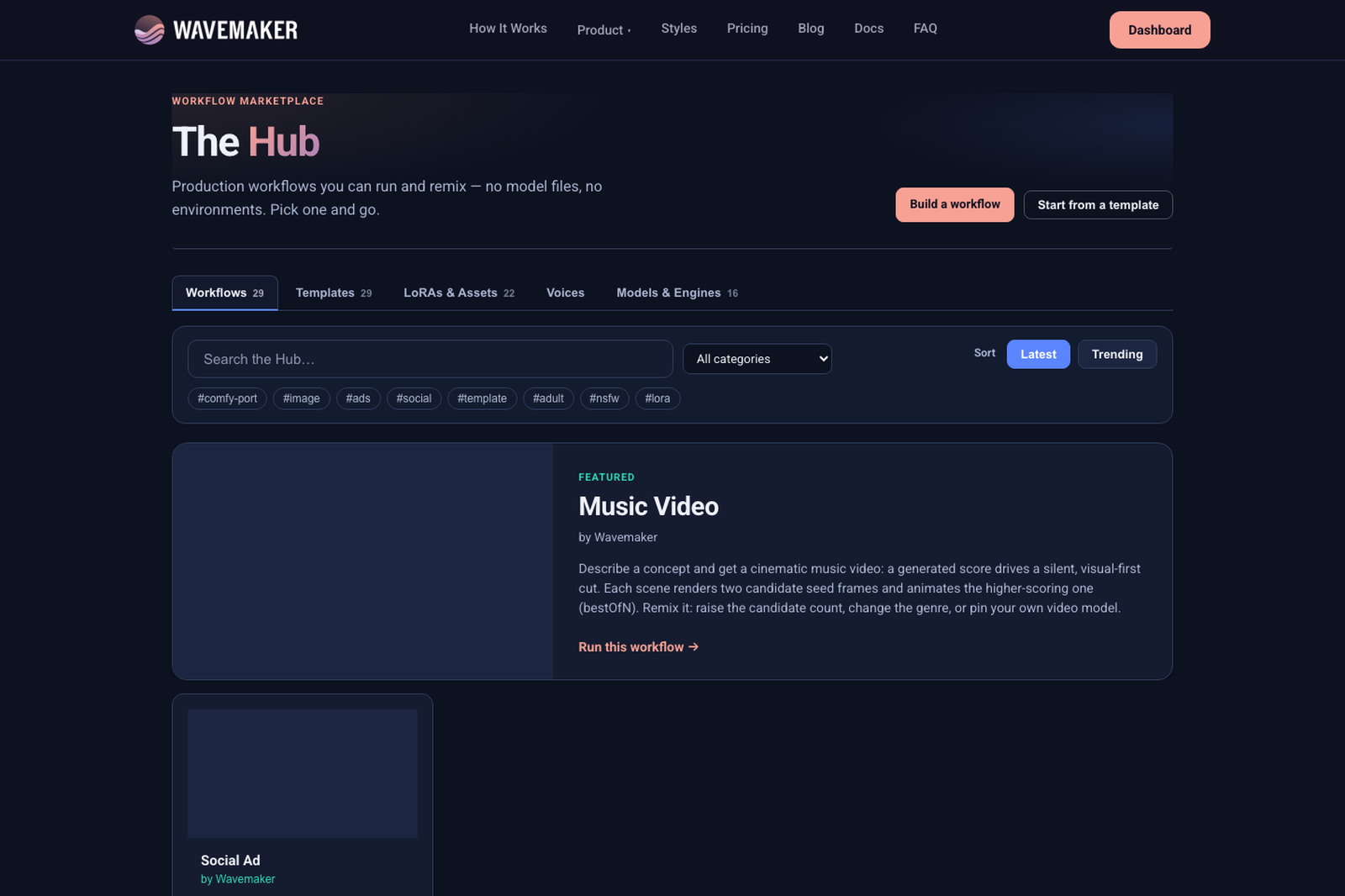
Hub catalog — browse runnable workflows and assets.
What should legal/compliance teams ask?
Questionnaires often ask whether third-party Python executes on user uploads. For Wavemaker transpile, the answer is no Comfy node execution — only typed blocks on managed engines. PNG parsing is client-side; only JSON transits after extraction. Document the import report as evidence of unsupported ControlNet/custom nodes rather than claiming feature parity with desktop Comfy.
Who should pick hosted ComfyUI?
Choose a hosted Comfy runtime if:
- Your graph is a custom-node sandwich (rare nodes, ControlNet stacks, in-Comfy video)
- You need seed-locked reproduction for audit or print
- You already operate Comfy ops and just want someone else’s GPU
Validate: node allowlist, model upload policy, pricing model (per-minute vs per-run), and what happens when a node 404s.
Validate: node allowlist, model upload policy, pricing model (per-minute vs per-run), and what happens when a node 404s.
How do education and onboarding differ between tools?
Comfy onboarding teaches git, pip, and VRAM tuning. Wavemaker onboarding teaches spec panels, quotes, and publish modes. Training internal teams to stop saying “same workflow” when they mean “same intent” prevents churn. New hires from Comfy backgrounds should read why transpile before filing parity bugs.
Who should pick transpile (Wavemaker)?
Choose Wavemaker if:
- Your graph is mostly prompt + LoRAs + t2i/img2img
- You want runners without GPUs and creators without leaking prompts
- You need API/MCP, webhooks, human approval, or video downstream
- You accept an import report instead of pretending everything mapped
Try: Run ComfyUI workflows online.
What about visual workflow builders that aren’t Comfy?
Tools like node-based automation builders (Make-style, general LLM flow UIs) solve different problems — often text orchestration, not diffusion graphs. Compare in ComfyUI vs visual workflow builders. Wavemaker’s builder is media-native: typed blocks with compile gates and per-block billing — closer to a production kernel than a Comfy skin.
Migration playbook (honest)
- Export Comfy API JSON (simplest) or UI save.
- Import at /workflows/new; screenshot the report.
- Import LoRAs to Training Studio on runnable hosts — /lora-training.
- Copilot-rebuild Not imported sections.
- Run twice; compare intent, not pixels.
- Publish when satisfied — Comfy to product.
FAQ for buyers evaluating vendors
Ask any “Comfy online” vendor:
- Do you execute custom node Python from my JSON?
- How do you price graphs with loops and upscalers?
- What happens when a node version mismatches?
- Can I hide my graph while charging per run?
- Do you offer typed REST with idempotency?
Wavemaker answers: no custom execution; per-block quote; platform blocks versioned; premium hide; yes — see /workflow-api and /comfyui.
Document the choice in your internal wiki so support does not promise Comfy parity on Wavemaker links.
Where to go next
- Import: Import ComfyUI workflows
- Formats: ComfyUI JSON formats explained
- Node pain: Custom nodes and dependency hell
- Pillar: /comfyui
Pick the architecture that matches what you refuse to give up — then migrate without lying to yourself about parity.
Frequently asked questions
- What is the best web-based ComfyUI alternative?
- It depends on fidelity vs product needs. Hosted ComfyUI clouds maximize node compatibility but inherit dependency and security issues. Wavemaker maximizes quoted runs, APIs, and review gates by transpiling graphs — not executing custom nodes.
- Is Wavemaker a hosted ComfyUI instance?
- No. Wavemaker imports Comfy JSON/PNG and transpiles creative intent onto typed blocks. ControlNet graphs, custom nodes, and subgraphs are unsupported; common WAN/AnimateDiff-style video chains map. Sampler/CFG/steps are dropped (image seed may ride) and reported.
- Can I migrate my Comfy workflows without reinstalling nodes?
- You can import supported structure (prompts, LoRAs on runnable hosts, t2i/img2img). Unsupported nodes appear in the import report for copilot-assisted rebuild — not silent emulation.
- Which option is better for selling workflows?
- Platforms with Hub pages, hidden premium graphs, slug APIs, and upfront quotes — Wavemaker's publish path — vs sharing JSON zips for self-hosted Comfy.